Man It Feels Like Space Again Bass Tab
Throughout the Beatles' 8 years of recorded content, the band reinvented songwriting and demonstrated a tremendous breadth of musical creativity during such a short menstruum of time. The band recorded everything from evidence tunes to ballads, songs inspired by Motown, songs inspired by the birth of rock in the 1950s, ballads, dejection pieces, R&B to encephalon-twisting psychedelic, and even more than all while blazing the path for with new recording techniques and pushing the envelope for what was possible in to tape in the studio.
Over all these musical changes, Paul McCartney adapted and showed his ability to create some of the golden-standards of bass playing regardless of what the song could be boxed into as a genre. McCartney could play simple root and fifth lines like on "Dear Me Do," "From Me to You," and "One After 909", rock 'n' roll eighth notes similar on "I Saw Her Standing At that place," "Long Tall Sally," and "Picayune Child", bass lines that pushed the vocal frontwards like on "Get Back," "Everybody's Got Something to Hide Except Me and My Monkey," and "I'thousand Downward", short repetitive grooves "Taxman," "Dr. Robert," and "Come Together", and even fast and flashy lines ("Rain," "Paperback Writer," "I Desire You (She's And then Heavy)").
But Paul was probably known best for his ability to craft melodic bass lines or bass lines that move through the chord changes rather than change with them equally they come up and works to smooth over the entire song. Using arpeggios and scalar passages, McCartney was among the first bass players in the forefront of modernistic stone music to
Of form, Paul McCartney was a natural melodist, having written some of the most memorable songs in the history of popular music. In this article, we'll wait at a few of McCartney'due south almost melodic electric bass passages and focus on some mutual patterns that he used to connect chords.
Here's a breakdown of 20 of the quintessential Paul McCartney bass lines:
1. "Taxman" – Revolver (1966)
If there was a more recognizable Beatles bass line, it tin't beat out "Taxman".
McCartney'due south bass work here is very straightforward but very singled-out and certainly can be argued to be the melodic element of the song. As George and John alternating between downstroke guitars on beats 2 and 4 throughout the verse, chorus and guitar solo sections, McCartney is keeping to the mid-to-upper register of the bass guitar to build out this bass line.

The most interesting attribute of this bass line is it's simplicity. The line'southward showtime pattern begins first on the chord'south root note D on the fifth fret and jumps to the octave D on the 7th fret on the Thou string. Then, it incorporates a hammer on on the D string from G to A and resolves back towards the high C.
This pattern is held until McCartney drops it downwards to outset on A natural on the corus and so downwards lower to begin on the M for the 2nd part of the chorus.
While McCartney's root notes stay in line with the chord changes of the song, the pattern of notes and bass line's rhythm stay consistent wherever Paul is playing the line on the neck.
2. "Something" – Abbey Route (1969)
Few bass lines best capture McCartney'southward melodic style of playing than the line played on "Something" off the Beatles' 1969 release, Abbey Road.
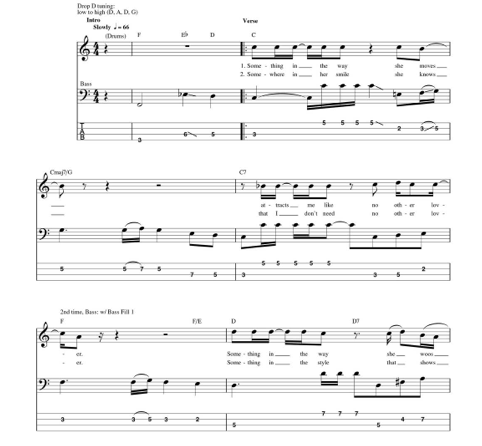
This first figure (left) outlines a department of the poesy and the bass line McCartney plays on it.
Immediately, someone looking to acquire this line can see that the bass very often completes the vocal melody and the spaces where the guitar playing is at it'due south least. Best shown on measure 3, mensurate 5 only before "Something in the way…", measure seven and eightto proper noun a few sections.
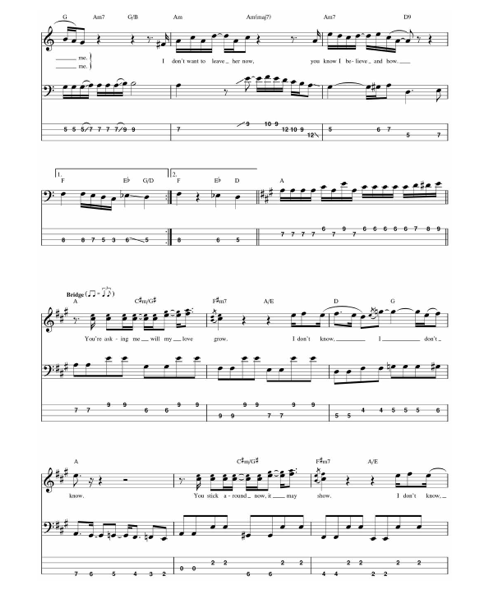
In the verses of "Something", Paul focuses his work on completing and complimenting the endings of Harrison's passages. Every two-4 bars, McCartney is right at that place usually with a very distinct 16th note run to punctuate the phrase or with a half or quarter note serial that sounds and resonates distinctly differently from the delicate comping guitars of Harrison and Lennon.
Moreover, Paul tends to begin his bass lines on the root notes of the chords being played but winds through the chord into the side by side i.
Information technology'southward this quality that makes a McCartney bass line so distinct: his ability to current of air and weave through chords both by combining note selection with rhythmic stardom from the rest of the instruments playing. Moreover, it's a theme that I'll refer back to over the course of this post considering the trait is just that apparent.
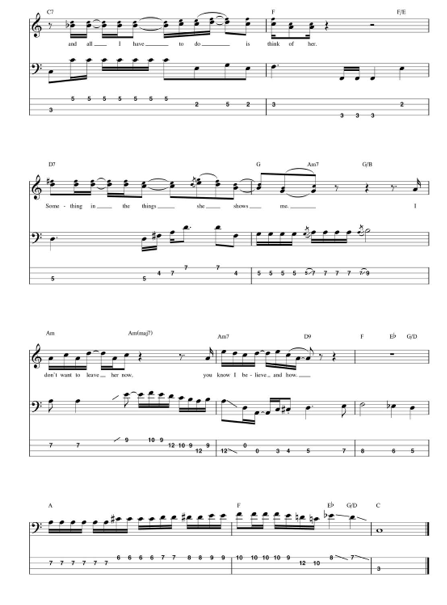
The bridge of "Something" is particularly interesting from a listener'south standpoint as well as from an observational perspective when looking at the sail music.
The first thing that stands out is but how busy the bass line is compared to the guitar work. The bridge is a fantastic case of Paul taking the musical atomic number 82 with the bass while still moving in step with the chord progression created by Harrison.
Whats more, McCartney is very generous with accents and annunciations during the span. Slides, hammer-ons and drops and jumps from one octave to another are very common here and only add to the lead qualities mentioned before.
As Harrison'southward vocals soar and reach a climax before entering the guitar solo, McCartney is correct there behind him with a scalar run of 16th notes (see the last 3 measures above) before dropping off with a low C – a musical period on this department of "Something" because of it'southward distinctness from the residual of the bass line upwardly to this point and from a song construction stand bespeak. The span is now over – time to enter the guitar solo.
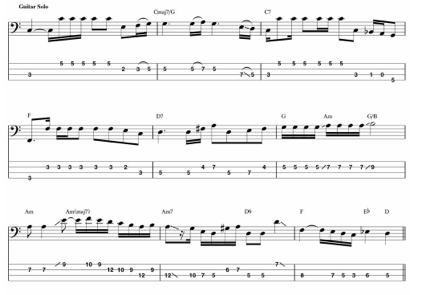
The final major point is the guitar solo of the vocal through to the finish.
McCartney revisits the bass theme established during the verse simply this time with a few variations including using more than scalar runs to connect chords and bars together. A good example of this is the 7th measure of the guitar solo department (see right) where beats iii and 4 are connected past a series of 16th notes running downward an E minor scale across an Amjr7 chord dorsum into an Am chord in the next bar.
3. "While My Guitar Gently Weeps" – The White Anthology (1968)
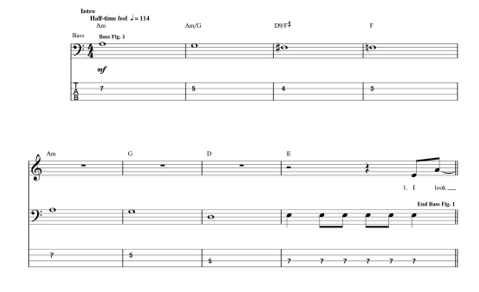
Unlike McCartney's work on "Something", Paul'southward bass work on George Harrison's classic, "While My Guitar Gently Weeps" takes on more than of a "traditional" bass guitar role, aimed at providing bottom end and structural back up to Harrison's vocal.
The introduction of "While My Guitar Gently Weeps" showcases Harrison's guitar work while McCartney provides whole notes
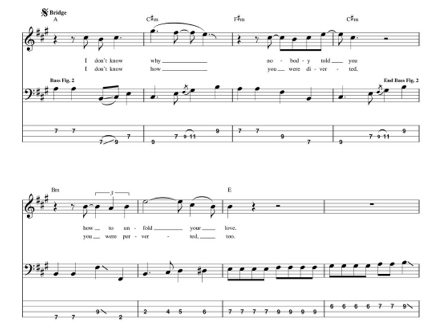
McCartney's playing is showcased most during the bridge of this song. While the sounds of a Hammond organ provide a groundwork of chords behind Harrison's singing, McCartney meshes aspects of a walking bass line together with slides and accent patterns to continue to requite the vocal a forwards moving feeling with a bit of weight to it.
Listening the recording, the almost stand-out notes that McCartney plays during the bridge section are in the kickoff measure out of the span where Paul will jump down from the high A to the B natural and build support the scale starting at B to A, then to Eastward, back downward to A and build back up across the first 2 measures of the section.
This pattern re-emerges on in the 5th bar when on beats 1 and 2, Paul starts on a B natural, jump to an F on beat 3 and slides down to D on beat 4 and rebuilds support through bar 6 so resolves and then entire passage beyond bars 7 and eight and leads into the verse (beneath) where Paul returns to rhythmic playing.
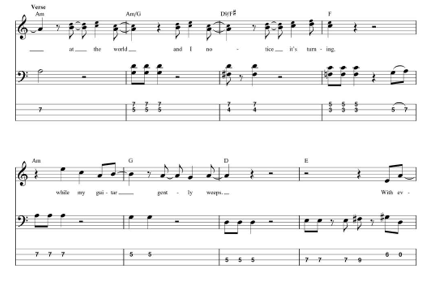
Paul's playing on "While My Guitar" sticks to filling a supportive role rather than a melodic part.
The pattern to the left is the theme consistent throughout the poesy: absolute playing on beats 1 and ii of each bar and a turnaround on bar 8.
Though at that place are variations on this theme as the verse progresses for it's full elapsing, this theme re-emerges as well during Harrison's first guitar solo and on the outro guitar solos as well (both figures below):
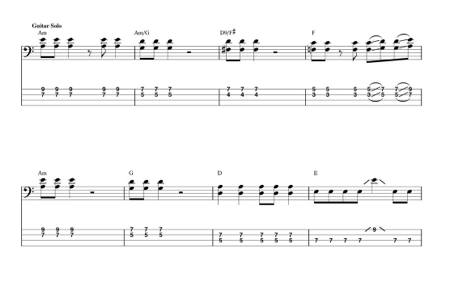
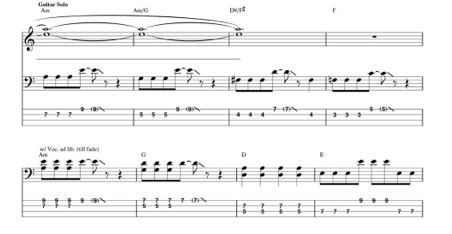
The vocal, as whole is an first-class showcase of Paul McCartney's more supportive role as a bass player rather than as a melodic, lead. A function – as we'll run across throughout this analysis – that he can perform merely as well every bit well as when he is taking the lead.
4. "Come Together" – Abbey Road (1969)
Merely every bit recognizable as "Taxman", "Come Together" is some other example of a unproblematic still incredibly claw-y Paul McCartney bass line. Though some argue that this was his best bass line (simply at the stop of the day, everyone has a "all-time Paul McCartney bass line" they tin can point to), this line is certainly one of the more memorable and a corking learning tool for a beginner bass player.
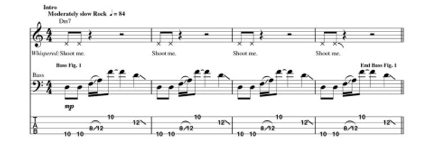
Like "Taxman", Paul's bass line for "Come Together" follows one primary theme (that doo-do-doda-bwahh-doo) that he establishes within the first iv confined of the song (left)
The song instantly hooks your ear because of all the contrast going on. What do I mean?
- The number of notes being played in the phrase. Guitars are largely absent and Ringo's pulsate part is very minimal – hullo hats and low-cal percussion only. Meanwhile, Paul is playing in the upper register of the bass AND working in a (relatively speaking) busy bass line
- The number of accents. Tying into the terminal bullet point, Paul's use of accents here – slides and hammer ons in particular – further distinguish the line from the rest of the vocal in conjunction with the points made from the bullet point above.
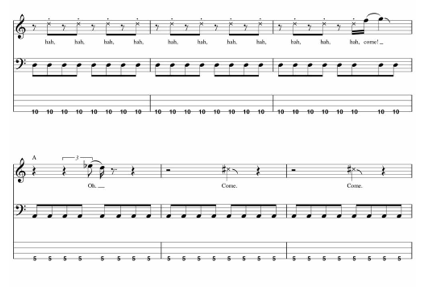
The chorus here is a archetype example of a catchy sing along chorus that the music supports wholeheartedly from the all instrument arrangements.
Paul'southward bass line here is just every bit straightforward and complimentary: pedaling eighth notes that move in lock-step with the chord changes.
The line hither is uncomplicated notwithstanding functional and designed to be complimentary and rhythmic rather than melodic and independent.
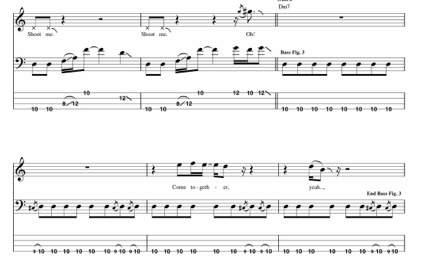
The outro of "Come Together" marries the theme from the intro and verse with the theme from the chorus with a small variation: the inclusion of hammer ons through to the terminate of the song.
The hammer ons in this example add the aforementioned qualities that the accents and note jumps made in the master theme of the song: to add a distinguishable quality from the guitar lines to the bass line.
5. "Hello, Good day" – Magical Mystery Tour (1967)
"Hello Good day" is a Beatles song off their 1967 anthology, Magical Mystery Tour. The song itself marries a whimsical song writing fashion characteristic of the mid-1960s Lennon/McCartney writing way too every bit elements of "simple song" writing of the 1950s love songs and Beach Boys pieces.
"Howdy Goodbye" is a bully case of a McCartney bass line that picks up steam in select areas of the the vocal for brief periods of time. Rather than an entire theme being the center point of, say, the verse or the bridge, information technology'south 4 bar runs that make the song a noteworthy piece in this list.
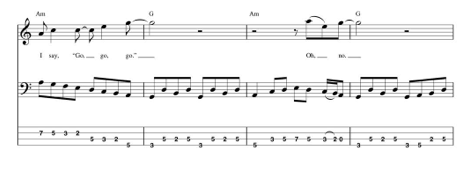
The instance that I'm referring to are the last 5 bars of the verse section of the vocal, where Ringo begins to outline the backbeat of the song earlier leading into the chorus ("Hello, hello, I don't know…")
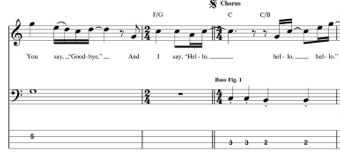
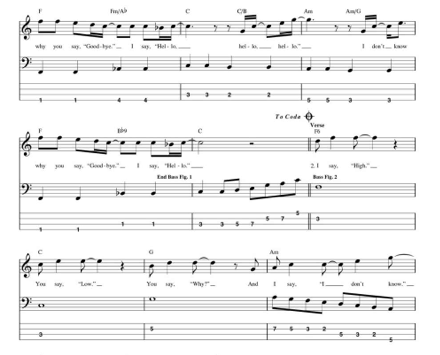
These 5 bars are the bars that drive the vocal in and out of the chorus and give the vocal itself a very distinct feeling of movement for a curt period of time.
Before and after this function, the song takes on a very carefree and floating quality supported by Lennon's characteristically airy vocals, a mid-range pianoforte hammering 8th notes and Paul's bass line but serving root functions through a quasi-walking bass line and parts that conclude the musical passage every four or 6 bars.
I say quasi-walking bass line because the bass line itself does not stay a walking bass line for more than a few bars at a time earlier breaking to hold for a whole note or to brand a short eighth note run to – again – resolve the musical passage (beneath):
six. "Happiness Is A Warm Gun" – The White Album (1968)
Jeez – what a song this one is!
"Happiness is a Warm Gun" off the Beatles' 1969 cocky titled double album (affectionately called, The White Anthology) is on this list simply for the reason that this vocal is the best case in the entire Beatles itemize of playing a melodic bass line through a boundless assortment of very irregular time changes.
If ever there was a better crash course in reading and counting rapid fourth dimension signature changes than this song, I can't call up of one.
Here'south a brusque overview of exactly how many time signature changes go on over the class of this song courtesy of the Beatles Bible:
- iv bars of 4/4
- ane bar of 4/four
- 1 bar of ii/4
- 5 bars of iv/four
- i bar of 5/4
- 1 bar of 4/4.
- 22 bars of 3/8)
- Three times through a bar each of 9/8 and 10/8
- iv bars of 4/iv
- 3 confined of 12/8 (with the drums doing 4 bars of four/4 and i bar of ii/iv)
- 5 confined of 4/4 (the final bar entering free time)
- i bar of 2/iv (in free fourth dimension)
- v bars of 4/four
Wow…
I'll give you a minute to check out all those time changes one more time.
In 1 vocal, the Beatles gave the entire progressive rock movement of the 1970s a run for their money.
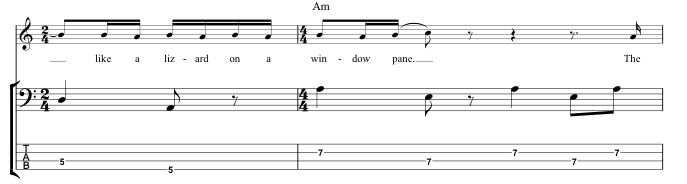
Inside the kickoff 8 bars of the song, in that location is already a time signature alter from 2/4 to iv/4 – specifically on bars 6 and 7 (pictured to a higher place). Though the bass line appears challenging, Paul is simply playing quarter notes across the chord changes of D modest (not shown – merely happens i bar earlier the change to 2/4) and Am, showtime on the root annotation and and then moving downwardly a perfect fourth in mensurate 6 and measure seven, and so moving support a fourth to the A.
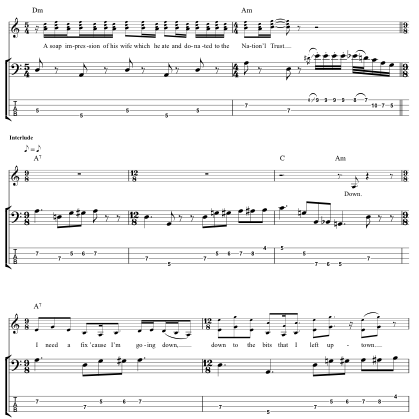
This adjacent excerpt is only 2 more bars into the vocal from the last excerpt. Similar the passage before, Paul's bass line is providing more of a framework to continue time with rather than to create a melodic tool with.
McCartney is returning to using walking bass line qualities showtime on the root note of the bar's chord and only using a handful of notes each time the time changes to a signature too irregular to become melodic or counter melodic with.
Even when the time changes again from a quarter note based feel (5/4, 4/iv) into an eighth note based feel (six/eight, 7/8, 9/8), McCartney'south bass playing stays uncharacteristically controlled, only outlining the downbeats dictated by the fourth dimension signature, the root notation of the chord and only small scalar steps beyond 3rds and 5ths.
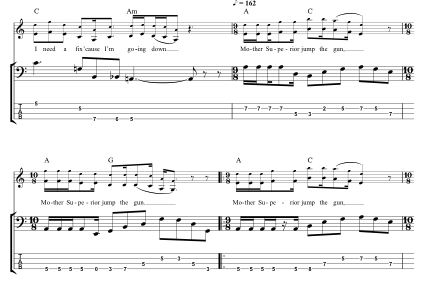
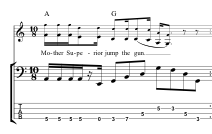
The post-obit passages highlight the back-and-forth between 10/8 and 9/viii.
*Before we become any further – a quick counting lesson: ii 16th notes have the same elapsing every bit 1 eighth note.
With the first pattern of ix/eight, Paul begins playing on an A before dropping down a 5th to the D and then building support the B major scale into the ten/8 bar.
Transitioning to the bar of 10/8 signifies the addition of only 1 eighth note. This is reflected by McCartney's bass line in these 10/8 confined by playing the exact aforementioned bass line every bit 9/eight but with the improver of the low One thousand at the end of the x/eight bar (see both confined of x/8)
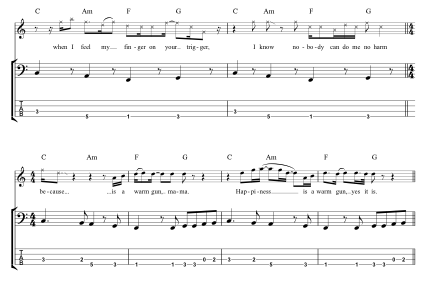
The last major section of this song is the chorus where the band returns back to 12/viii time which is another way of counting 4/4.
*Quick counting lesson once more! A quarter has the value of 2 eighth notes. So when looking at this bass line and we see a quarter note and an eighth rest, it's counted 1-2-iii, ane-2-3, one-ii-three, 1-ii-iii | ane-2-three, etc. In other words 12/eight has 4 groupings of 3 8th notes.
Bearing this counting lesson in mind, Paul's bass line doesn't seem so cryptic.
7. "Lucy In the Sky With Diamonds" –Sgt. Pepper's Lonely Hearts Club Band (1967)
The classic psychedelic epic inspired by a young daughter that John Lennon also comes with a bass line that mirrors something Ballad Kaye would accept come upward with.
In the poetry of this song, McCartney lays down a foundation of half and whole notes underneath Lennon and George Harrison's guitar piece of work:
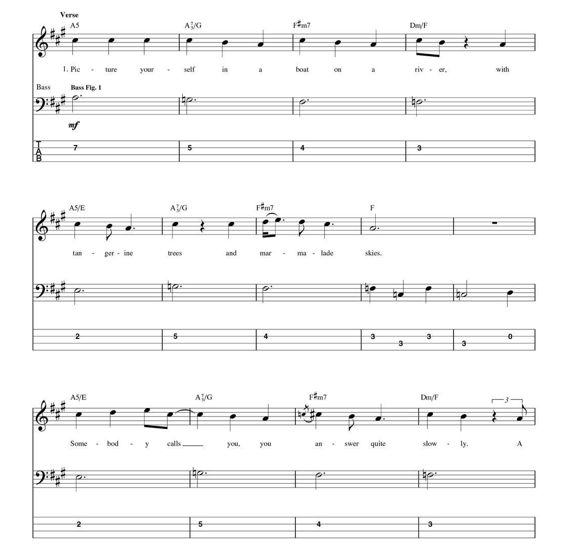
The chord progression is rather straight forward from the perspective of Lennon and Harrison'due south playing, and to a certain extent, as is McCartney's bass playing.
Through nigh of these runs, Paul is playing root notes and following along with the guitar part.
Information technology's not until the pre-chorus does Paul whip out a textbook instance of a walking bass line.
As the guitar parts and Star'south snare lucifer the chugging, predictable feel of the chorus, Paul is weaving through the chords and through the eighth notes with a walking bass line:
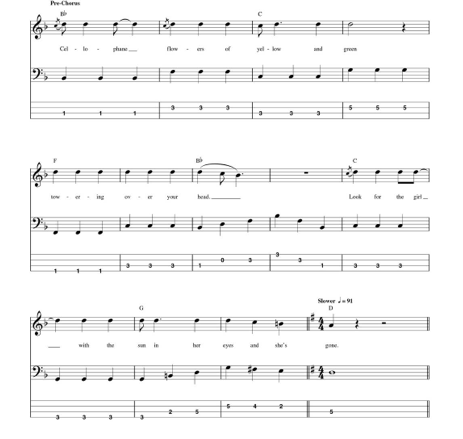 Every bit the song itself builds, and so does the complexity of Paul'southward bass playing.
As the chrorus unveils and the cymbals are crashing and Lennon is singing, "Lucy in the sky with diamonds/Lucy in the sky with diamonds", Paul is edifice off of the walking bass line established in the pre-chorus and calculation boosted "in-between" notes to make information technology both through the chord progression and from one note to the adjacent, all while providing the melody for the chorus as the guitars provide the rhythm.
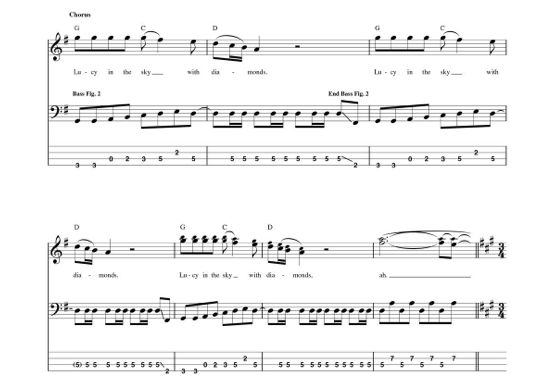
McCartney is very clearly taking advantage of the rests of the guitars on beats 3 and 4 and taking the opportunity to fill those breaks with additional rhythmic back up in the form of root notes, scalar runs, slides and billowy between the root and fifth note of the chord being laid out by Harrison and Lennon.
8. "Hey Bulldog" – Yellowish Submarine (1968)
A personal favorite to play, "Hey Bulldog" came out on the 1968 release, Yellow Submarine. This vocal made it to the listing considering of the "non-stop-playing" quality of this bass line.
Few McCartney bass lines go on the entire song with few to no rests and this is ane of those examples.

Similar many of the songs on this list, a major theme or hook is established within the first 4-eight bars of the song, only unlike other Beatles songs mentioned on this list, the introduction of this song establishes gradually builds over the course of 6 bars rather than merely repeating in total organisation. McCartney joins in the theme during the last 6 bars (to a higher place)
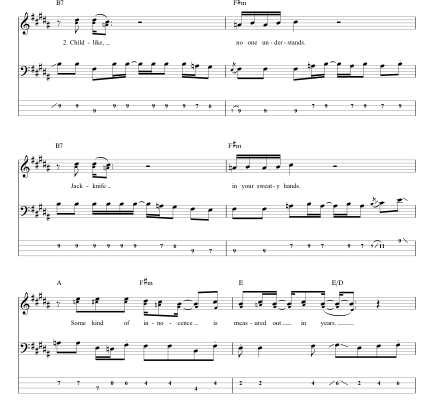
What'due south also interesting about McCartney's work on this song is that the bass line seldom stops to rest. The bass line continues throughout the song arguably beingness the sole factor giving the song it's bouncy but moving quality with a combination of eighth notation and 16th annotation runs up and down the chord progression outlined by Lennon and Harrison.
McCartney's bass line too is unique during the poetry sections for it'due south ability to play either in lock step with the eighth notation piano in the groundwork of the vocal and Ringo'southward hi hat or play in-between them with short 16th note runs, best outlined in each of the measures presented in the excerpt above.
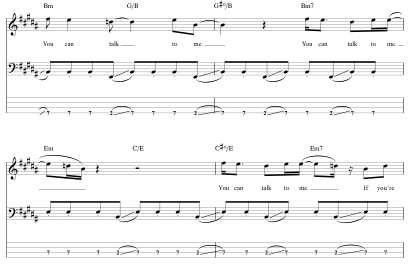
The chorus section (left) is distinct from the remainder of the vocal because of the use of a limited set of notes and the incorporation of slides to motion upwardly and downwardly from the low and heart sections of the bass.
During the guitar solos and the outro portions of the song, McCartney revisits playing patterns that were established earlier in the song'due south verses sections. Like before, the bass lines provide a strong rhythmic undercurrent to the song while Harrison's guitar solo takes place and while the concluding chorus of the song is being sung taking the song to the decision.
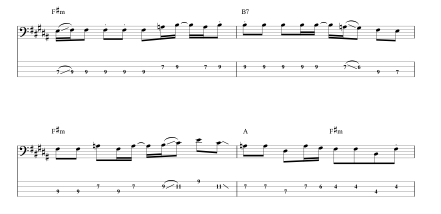
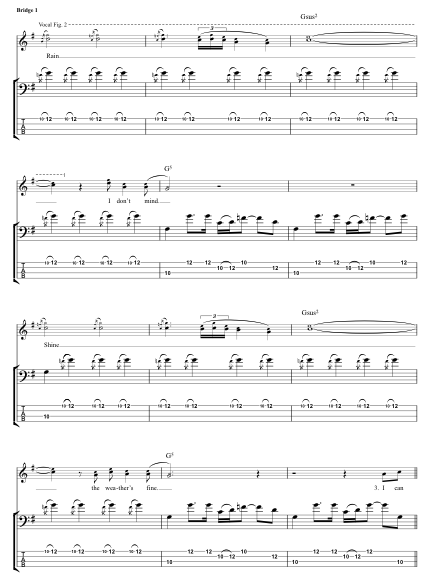
nine. "Rain" – single
"Rain" was a single released by the Beatles in 1966 as the B-side to "Paperback Author", the leading single off the ring'due south 1965 release, Rubber Soul. "Rain" was also one of the beginning Beatles singles to receive a promotional video release with the vocal.
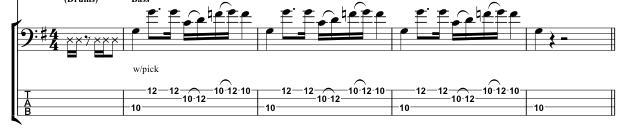
It's of import to meet that "Pelting" is only based off of 4 chords:
- G major
- Csus2
- D7sus4
- Gsus4
- Cmaj9
- G7sus4
The latter four chords of this song only announced towards the bridge and last chorus briefly. For the most part, the song is based off of ii chords: G major and Csus2.
Why did I bring this detail up?
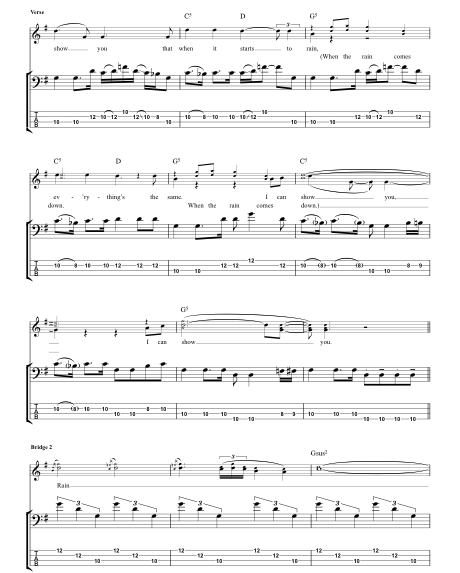
Because these few (and seemingly bizarre, sonically "incomplete-sounding" chords) are what, first, set the sonic backdrop for "Rain" and are what help to make Paul'due south bass line pop fifty-fifty more.
While the bass line begins each of information technology's patterns on each of the root notes of the chord, it helps to discover that the vocal tune and the guitar parts are very thin, very staggered and very winding and psychedelic compared to the bass line which is very flowing in a anticipated up-and-downwards pattern both outlined by how the notes are bundled and how the line actually sounds within the context of the vocal.
The other portion of this track worth noting is the bridge section. Paul changes up his playing significantly from the theme he established back during the poetry, chorus and introduction.
While John, Paul and George all harmonize the word rain and continue to strum Thou and C chords, Paul is hammering F onto G, harmonizing his bass an octave above the root notation of the G when John and George are playing the 1000 major and Gsus4 chord. Moreover, when the chord progression moves through the D and the C major chords (not shown in this excerpt), Paul continues to hammer the loftier Grand which ends up harmonizing the perfect 4th of the D chord and the perfect 5th of the C chord.
All the same another of Sir Paul figuring it all out and playing what a slap-up bass role player does: what fits and what works for the song.
ten. "And Your Bird Can Sing" – Revolver (1966)
"And Your Bird Can Sing" is the last song on this Paul McCartney bass line roundup.
This vocal was track number 9 on the Beatles' first major pace into the realm of psychedelic and world music with their 1966 album, Revolver.
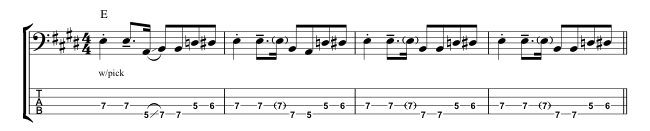
The introduction of this vocal hits y'all with total force: a 2 pronged attack of the main theme (after to be revisited during the chorus section) played in unison by Harrison and Lennon while McCartney plays countermelody underneath (pictured above). To give a petty chip more than perspective how Paul'southward bass line looks and fits with regard to the descending guitar line, here's what Lennon and Harrison are playing:

Paul's bass line, compared to the guitar line, is significantly less linear and less scalar than the guitar role, merely joins the guitars on the eighth notes on beats 3 and 4 in bars one and two.
Lining upwards each of these eighth notes together creates a very interesting countermelody/melody relationship. Both passages start on a B natural but then split similar this:
Bar 1 – Beat 3 and 4
Bass: B – B – D natural – D precipitous
Guitar: F – East – D – E
Bar 2 – Beat 3 and 4:
Bass: B – A – D natural – D sharp
Guitar: Grand – D – E – F
Bearing in mind that this vocal is in the key of Eastward (4 sharps; F#, 1000#, C# and D#), and the chord over McCartney, Lennon and Harrison'south parts is an E major chord means that McCartney's bass line harmonizes the perfect 5th, pocket-sized 7 and dominant 7th on beats three and 4 of the Eastward major chord while the guitars harmonize the minor 2nd, root, minor seventh and root during bar 1 and and the minor 3rd, minor seventh, root and minor second during bar two.
E'er wonder why the intro to this vocal sounds to heady and in-your-confront with sound and texture? That's why.
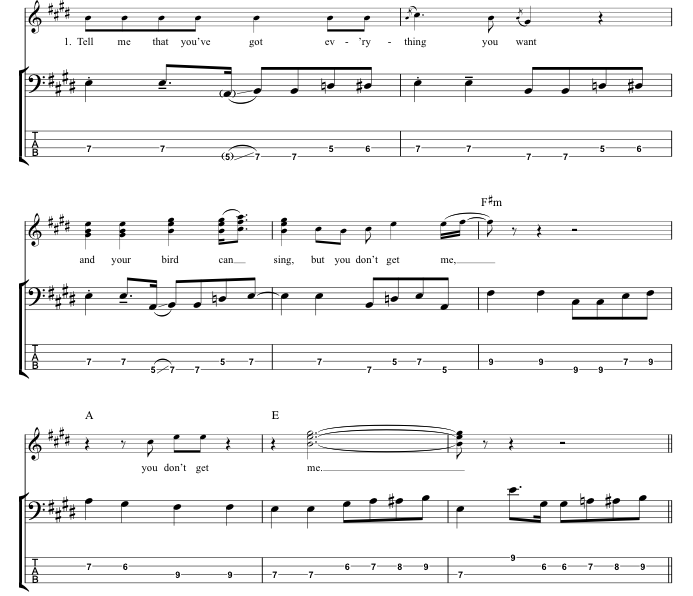
During the poesy section, McCartney switches to a quasi-walking bass line,reminiscent of what we touched on during the breakup of "Hello, Goodbye" above. Either a quarter notation passage volition fill the space on beats 1 and ii like in measures 2, v and 7 of the higher up excerpt followed past eighth notes on beats iii and four on the same measures. Other times, McCartney will only play a quarter annotation on the downbeat of beat 1 usually the root note of the chord followed by a a dotted 8th note-16th annotation tie into the downbeat of beat 3 similar in measures ane and 3 or one without a tie.
The exception to all of this is measure 6 where the unabridged bar is a decending scalar quarter notation run starting on the A. Listening to the rail, this is the part that sticks out clearly and the part that nigh people volition hear without having to actively listen to the track.
Why does this stand out?
Check out the measure. Discover the rests that are in that measure and how much infinite is left open for the bass to fill. Rather than fill it with a decorated flurry of 16th notes that might take jeaprodized the movement and overall feel of the vocal, McCartney chose to keep with steady, walking quarter notes that fulfill the melodic elements of the song as a whole too as the melodic elements of this item part of the vocal. Smart move.
Conclusion
Whew! And then that wraps up my first breakdown of a bass player'due south (arguably) some of the all-time bass lines of Paul McCartney.
What did we become from this? Well, McCartney was a pretty smart guy when it came to bass playing. His playing style could best be characterized as melodic, colorful, driving and complimentary. It harkens back to the playing styles of session greats similar Carol Kaye and James Jamerson and other RnB bass players who were popular in the The states during the 1950s and 1960s.
Some of Paul's playing is deceptively challenging. "Happiness is a Warm Gun" is a great case of the secret challenge that lies beneath
– – –
Now I desire to hear from you!
What did you call up? What did I miss? What did I become wrong? Should I exercise this kind of post once more for another bass player?
Shoot me an electronic mail at [email protected]
What do you recall is a must-know Paul McCartney bass line?
lawrencemorty1992.blogspot.com
Source: https://smartbassguitar.com/must-know-paul-mccartney-bass-lines/

Post a Comment for "Man It Feels Like Space Again Bass Tab"