The Ars Moriendi Tradition Was Concerned Mostly With the Art of
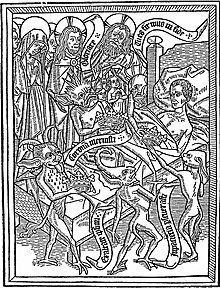
Pride of the spirit is one of the five temptations of the dying man, according to Ars moriendi . Hither, demons tempt the dying man with crowns (a medieval apologue to earthly pride) under the disapproving gaze of Mary, Christ and God. Woodblock seven (4a) of eleven, Netherlands, circa 1460.
The Ars moriendi ("The Art of Dying") are two related Latin texts dating from about 1415 and 1450 which offer communication on the protocols and procedures of a adept expiry, explaining how to "dice well" according to Christian precepts of the tardily Middle Ages. It was written within the historical context of the effects of the macabre horrors of the Black Death 60 years before and consequent social upheavals of the 15th century. The earliest versions were nearly likely composed in southern Frg.[one] It was very popular, translated into most W European languages, and was the first in a western literary tradition of guides to expiry and dying. About 50,000 copies were printed in the incunabula flow earlier 1501 and further editions were printed later on 1501.[ii] [three] [4] Its popularity reduced every bit Erasmus's treatise on preparing for death (de praeparatione ad mortem, 1533) became more than pop.
In that location was originally a "long version" and a later "curt version" containing eleven woodcut pictures every bit instructive images which could be hands explained and memorized. These woodcut images were circulated in both print and individual engravings.[1] They could then easily exist pinned to a wall for viewing.[one]
The authors of the ii texts are unknown, but causeless to exist Dominican churchmen, every bit they echo Jean de Gerson'southward publication, the Opusculum Tripartitu, containing a section named De arte Moriendi. Gerson may take been influenced past earlier references in 'compendia of faith' dating dorsum to the thirteenth century, only the content was uniquely his ain.[5]
Long version [edit]
The original "long version", chosen Tractatus (or Speculum) artis bene moriendi, was equanimous in 1415 by an anonymous Dominican friar, probably at the request of the Council of Constance (1414–1418, Federal republic of germany).[6] This was widely read and translated into virtually West European languages, and was very popular in England, where a tradition of consolatory expiry literature survived until the 17th century. Works in the English tradition include The Way of Dying Well and The Ill Mannes Salve. In 1650, Holy Living and Holy Dying became the "artistic climax" of the tradition that had begun with Ars moriendi.[7]
Ars Moriendi was also amid the showtime books printed with movable type and was widely circulated in nigh 100 editions before 1500, in item in Germany. The long version survives in near 300 manuscript versions, only one illustrated.
Ars moriendi consists of six capacity:[6]
- The beginning affiliate explains that dying has a good side, and serves to console the dying human that death is not something to be agape of.
- The second chapter outlines the five temptations that beset a dying human, and how to avert them. These are lack of faith, despair, impatience, spiritual pride and avarice.
- The third affiliate lists the 7 questions to ask a dying man, along with alleviation bachelor to him through the redemptive powers of Christ'due south love.
- The fourth chapter expresses the need to imitate Christ'due south life.
- The fifth affiliate addresses the friends and family, outlining the general rules of behavior at the deathbed.
- The 6th affiliate includes appropriate prayers to exist said for a dying man.
Short version [edit]
The "short version", whose advent before long precedes the introduction in the 1460s of block books (books printed from carved blocks of wood, both text and images on the aforementioned block), first dates to effectually 1450, from kingdom of the netherlands.[6] It is mostly an accommodation of the 2nd chapter of the "long version", and contains xi woodcut pictures. The first ten woodcuts are divided into v pairs, with each gear up showing a movie of the devil presenting one of the 5 temptations, and the second picture showing the proper remedy for that temptation. The last woodcut shows the dying human being, presumably having successfully navigated the maze of temptations, being accepted into sky, and the devils going back to hell in confusion.
The "short version" was as popular as the "long version", but there was no English translation, mayhap because educated English people at the time were expected to understand several European languages. There are half-dozen extant manuscripts of the short version, most not illustrated, and over twenty extant blockbook illustrated editions, using 13 dissimilar sets of blocks.[eight]
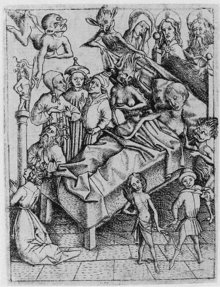
Temptation of lack of Faith; engraving by Primary Eastward. S., circa 1450
The images [edit]
Also as the xi different sets of blockbook woodcuts, there is a set by Master E. S. in engraving. The lengthy controversy over their respective dating and priority is at present resolved by the discovery by Fritz Saxl of an earlier illuminated manuscript, of well before 1450, from whose tradition all the images in the printed versions clearly derive. Studies of the watermarks of the blockbooks by Allen Stevenson at the British Museum in the 1960s confirmed that none of them predated the 1460s, so Master East. S.' engravings are the earliest printed versions, dating from around 1450. The images remain largely the same in all media for the residual of the century.[9]
There is the exceptional number of nigh seventy incunabulum editions, in a multifariousness of languages, from Catalan to Dutch, the earliest from about 1474 from Cologne.[10]
Allegorically the images depicted the contest between angels and demons over the fate of the dying homo. In his dying desperation his soul emerges from his mouth to be received by one of a band of angels. The soul was oft depicted as a miniature person who would either exist escorted to sky by the angels or sent to the fires of hell or years in Purgatory.[xi] Mutual themes portrayed by illustrators include skeletons, the Last Judgement, corpses, and the forces of good and evil contesting over souls.[2]
Extended tradition [edit]
The popularity of the Ars moriendi texts adult into a broader tradition of writing on the good death. Jeremy Taylor'south books Holy Living and Holy Dying, published in 1650 and 1651, exemplify that tradition. Information technology developed in both Protestant and Catholic veins and continued in diverse forms through the nineteenth century.
See also [edit]
- Bardo Thodol, Tibetan book of the Dead
- Book of the Dead, Egyptian volume of the Expressionless
- Consolatio
- Danse Macabre
- Memento mori
- Speculum Humanae Salvationis
- Vanitas
Notes [edit]
- ^ a b c Lyons, Martyn (2011). Books: A Living History. Los Angeles: J. Paul Getty Museum. p. 91. ISBN978-i-60606-083-4.
- ^ a b Martyn Lyons (2011). Books: A Living History. ISBN 978-1-60606-083-4
- ^ Reinis, Austra (2007). Reforming the Art of Dying: The Ars Moriendi in the German language Reformation (1519-1528). Ashgate Publishing, Ltd. ISBN978-0-7546-5439-ane.
- ^ "WorldCat Results for 'ars moriendi'". www.worldcat.org . Retrieved 2020-02-25 .
- ^ Paul, Kathryn (2015). "The Ars Moriendi: A Practical Approach To Dying Well". Modern Believing. ATLASerials. 56 (two): 213. doi:x.3828/mb.2015.19. ISSN 1353-1425.
- ^ a b c Due north.F. Blake (1982). "Ars Moriendi". Dictionary of the Middle Ages. v.1, pp547-viii. ISBN 0-684-16760-3
- ^ Nancy Beaty (1970). The Arts and crafts of Dying: A Written report of the Literary Traditions of the Ars Moriendi in England. ISBN 0-300-01336-1
- ^ A Hyatt Mayor (1971), Prints and People, Metropolitan Museum of Art/Princeton, numbers 23-25.ISBN 0-691-00326-2
- ^ Alan Shestack (1967). Master E. S., exhibition catalogue, Philadelphia Museum of Art, exhibit numbers 4-15
- ^ "ISTC, British Library". 138.253.81.72. 2005-10-27. Archived from the original on 2007-x-06. Retrieved 2013-01-14 .
- ^ Lyons, M. (2011). Books: A Living History. Getty Publications.
References [edit]
- Anonymous. "The Art of Dying Well", in Medieval Pop Faith, 1000–1500, a Reader. Ed. John Shinners, London: Broadview Printing, 1997: 525-535. ISBN 1-55111-133-0, English translation.
- Campbell, Jeffrey (1995) "The Ars Moriendi": An test, translation, and collation of the manuscripts of the shorter Latin version., Thesis (M.A.), Academy of Ottawa, 1995, ISBN 0-612-07840-X
- Caxton, William. Early English translation on Wikisource: The book of the craft of dying (London, 1917).
- Caxton, William, ca. 1422-1491; Seuse, Heinrich, 1295-1366; Comper, Frances One thousand. M; Congreve, George, 1836-, The book of the craft of dying, and other early English tracts concerning death. (London, 1917).
- Dugdale, Lydia. Dying in the Twenty-First Century: Toward a New Upstanding Framework for the Art of Dying Well (MIT Printing, 2015).
- Forcen, F. E., & Espi Forcen, C. (2016). Ars Moriendi: Coping with death in the Late Centre Ages. Palliative & Supportive Care. xiv(5), 553–560.
External links [edit]
- Digitized images of a photographic reprint the offset printed edition (in Latin)
- Xi woodblock pictures presented in framed pairs. German language language.
- Ars Moriendi page past page {Rosenwald 424} - L'art de Bien Vivre et de Bien Mourir, etcet – at the Library of Congress, circa 1493
- Ars moriendi in Castilian, with an introduction by East. Michael Gerli of Georgetown University.
- Ars Moriendi, by Donald F. Duclow.
- Danemunro.com, an article on memento mori and ars moriendi appearing in the publication of Dane Munro, Memento Mori, a companion to the most beautiful flooring in the world (Malta, 2005) ISBN 9789993290117, two vols. The ars moriendi eulogies of the Knights of the Gild of St John.
- Ars moriendi. Deutschland, ca. 1466 24 leaves. 11 illus. 28.7 cm. From the Rare Book and Special Collections Division at the Library of Congress
- Ars moriendi. Germany, ca. 1470? 14 leaves. illus. 35 cm. From the Rare Book and Special Collections Segmentation at the Library of Congress
- Ars moriendi. Federal republic of germany, ca. 1475? 14 leaves (the first blank, wanting). woodcuts: xi illus. xiii.9 cm. From the Rare Book and Special Collections Division at the Library of Congress
lawrencemorty1992.blogspot.com
Source: https://en.wikipedia.org/wiki/Ars_moriendi

Post a Comment for "The Ars Moriendi Tradition Was Concerned Mostly With the Art of"